
The best hard shell rooftop tent is decided by four parts you can measure: the shell material, the number of hydraulic struts, the base frame, and the hydrostatic head of the canvas. Everything else on the listing is styling.
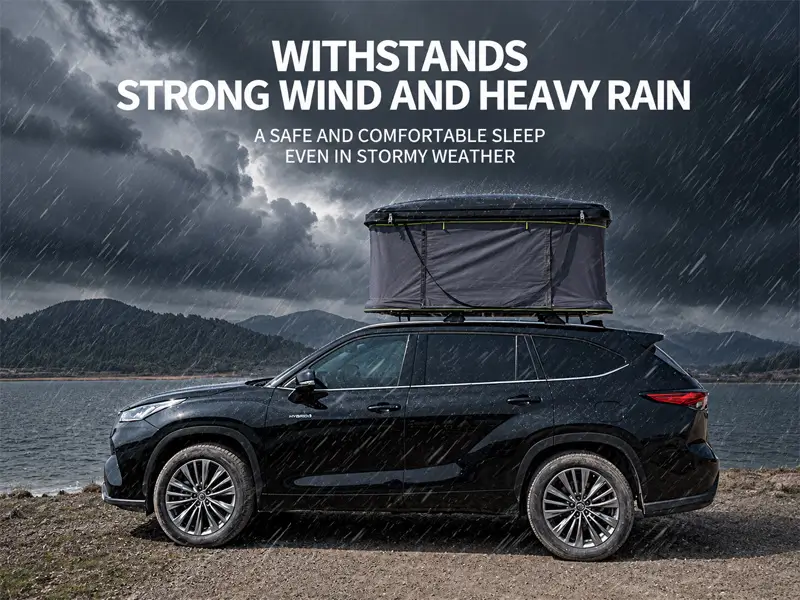
What is a roof top tent, and are they worth it
A roof top tent is a sleeping compartment that mounts on the roof bars of a vehicle instead of on the ground. What it buys you is distance from wet ground, stones and insects, and a setup that does not depend on finding a dry, level pitch. What it costs is money, fuel, and a roof load you have to check before you buy.
Search interest in whether roof top tents are worth it comes down to three trade-offs. They are worth it if you move camp often, because the tent is always with you and always ready. They are not worth it if the vehicle is a daily driver in a city, because 53–64 kg on the roof costs fuel every day for a benefit used a few weekends a year. And they are only worth it on a vehicle whose dynamic roof load is rated for the shell plus the people inside it.
Rooftop tent vs ground tent
The honest pros and cons of rooftop tents only show up against a ground tent, which is the alternative most buyers are actually weighing.
| Rooftop tent | Ground tent | |
|---|---|---|
| Setup | 3 seconds on a hard shell | 5–15 minutes, plus pegging |
| Ground conditions | Unaffected by wet or rocky ground | Needs a level, drainable pitch |
| Vehicle needed | Roof bars with adequate load rating | Any vehicle or none |
| Weight penalty | 53–64 kg carried permanently | Carried only when camping |
| Cost | Higher | Lower |
| Best for | Frequent moves, one-night stops | Base camps, long stays, hiking |
The decision rule most buyers land on: if the trip involves moving every day, a rooftop tent wins on time and comfort. If the trip is one camp for a week, a ground tent wins on cost and on not carrying 60 kg up every hill.
How to choose a roof top tent in four checks
Choosing comes down to the four measurable parts below — shell, struts, frame, canvas — in that order. Interior height and mattress width come next, because they decide whether the tent is usable in rain for more than a night.
Hard shell versus soft shell
A soft shell rooftop tent folds like a roof tent always has: fabric walls, a folding mattress, and a travel cover held down by straps or a zip. A hard shell replaces the cover with a rigid lid on gas struts. Push the lid up and the tent is standing.
That difference has three consequences worth knowing before buying:
- Setup time — a hard shell opens in seconds from one position; a soft shell needs the cover removed, the ladder placed and the walls pulled out.
- Wind and rain — a rigid lid sheds water and does not flap. Fabric covers collect water in the folds and flap in wind, which is the main source of noise at night.
- Weight and height — a hard shell is heavier and sits as a solid box, which affects fuel use more than a soft shell does.
What separates the best hard shell rooftop tent from the rest
The reference model used throughout this guide is our hard shell roof top tent, so the numbers below can be checked against a real specification rather than a category average.
The shell material
Thick ABS is the normal choice. It takes impact without cracking, resists UV yellowing better than thin plastic, and can be moulded into a curved profile — which matters because a curved lid sheds water and reduces wind noise.
Fibreglass shells are lighter and stiffer, but they chip and the chips show. Aluminium shells are the lightest and most expensive. What to avoid is a thin single-skin plastic lid: it flexes in wind, the flex works the hinge, and the hinge is not replaceable.
The struts
This is the part that decides whether the tent is usable alone. A single strut lifts one side and the lid twists; two struts lift evenly and hold the lid against wind from either side.
Dual struts are also what makes the shell stable when open. This tent runs two hydraulic struts, quoted to hold against level 7 wind, with the lid opening on a push and closing on a pull.
The base frame
All the load — shell, mattress, two adults — passes through the base into the roof bars. A frame in aluminium with stainless reinforcement spreads that load across the whole footprint rather than concentrating it at four mounting points.
The frame on this model is quoted at 400 kg load capacity, which is roughly twice what two adults plus gear will ever put on it. That margin is what stops the base flexing on corrugated roads.
The canvas
Hydrostatic head is the number to compare. Under 3,000 mm is a fair-weather tent; 5,000 mm is a three-season tent; 8,000 mm is what you want if the tent will be used in sustained rain. The figure is a hydrostatic head measurement taken on flat fabric, which is why seam construction matters as much as the number itself.
Waterproofing and ventilation together
Rooftop tents have a ventilation problem that ground tents do not: the whole shell is exposed, so condensation forms on the inside of the lid overnight and drips onto the mattress.
Two things solve it. The first is a double-layer door — mesh inside, fabric outside — so the tent can be vented without being opened to insects. The second is an insulated or lined roof panel, which stops the lid surface getting cold enough to condense in the first place.
This tent uses the double-layer door on both openings, with two doors and two windows for cross-flow, and an optional padded roof lining that can be taken out in summer.
Rooftop tent set up and hydraulic lift in practice
Push the lid up, the struts take over and the shell stands. Pull it down, the struts resist and the shell closes onto its latches. The whole rooftop tent set up is three seconds, and it can be done from one side.
Two details matter more than the speed claim. The latches should be stainless — a plated latch rusts at the first sign of road salt and then seizes. And the struts should be rated for the shell weight with margin, because a strut that is marginal will not hold the lid open in wind.
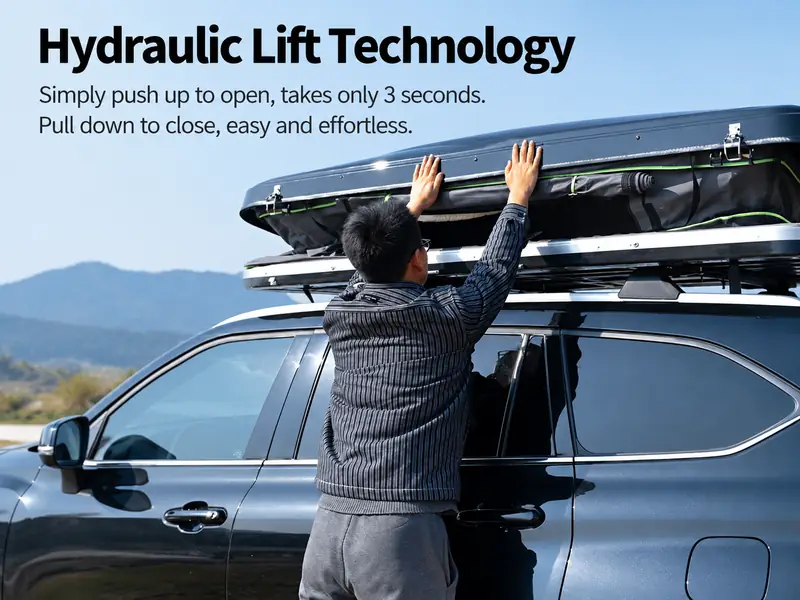
Interior height and rooftop tent mattress
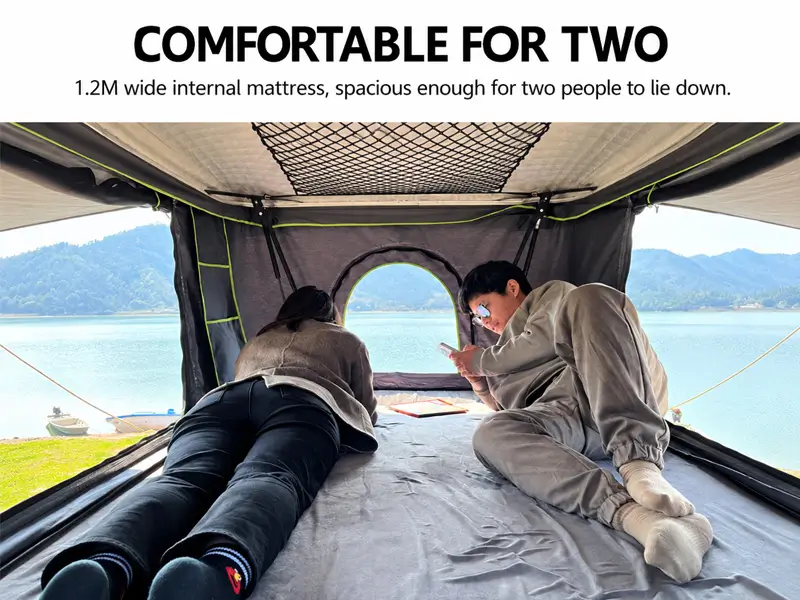
Interior height is the specification buyers underestimate. At 1.05 m a single person can sit upright and read; below about 0.95 m the tent becomes a place to lie down and nothing else.
The rooftop tent mattress on this model is 1.2 m wide, which is two adults lying side by side with a little room, or one person with gear. Interior length runs the full footprint, so neither occupant is curled up. If the tent is used in cold weather, a roof top tent of this size also takes an aftermarket tent insulation liner under the mattress, which adds a measurable layer between the sleeper and the cold base.
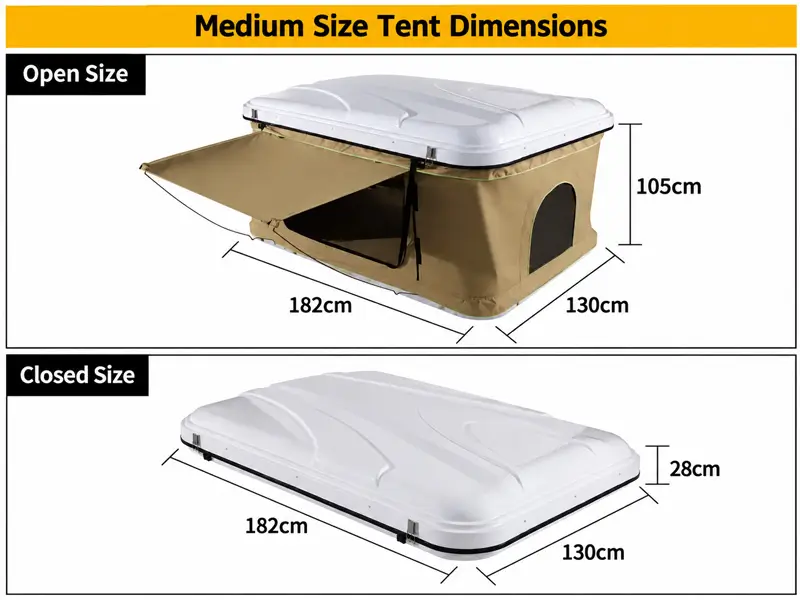
Two sizes
| Medium | Large | |
|---|---|---|
| Closed | 182 × 130 × 28 cm | 215 × 130 × 32 cm |
| Open | 182 × 130 × 105 cm | 215 × 130 × 105 cm |
| Net weight | 53 kg | 64 kg |
| Gross weight | 65 kg | 78 kg |
Both are 130 cm wide and 105 cm tall open; the difference is length. The medium fits shorter vehicles and leaves roof space for a box or awning; the large gives an extra 33 cm of sleeping length, which matters for taller occupants.
Fitment and accessories
The mounting system is designed to sit on standard crossbars rather than a proprietary rail, which is what makes one shell fit sedans, compact SUVs, full-size SUVs and pickups. The usual requirement is a roof bar rated for the shell weight plus occupants — check the vehicle’s dynamic roof load before ordering, not after.
What ships with the tent decides how much extra you have to buy: this model includes the aluminium crossbars, an aluminium telescopic ladder, a mattress, a tool kit, guy lines and a side pocket.
What to check at the factory
For buyers placing a container order, the tent is easy to photograph and hard to inspect. Five things are worth checking in person or on a live video call, because none of them show up in a product listing.
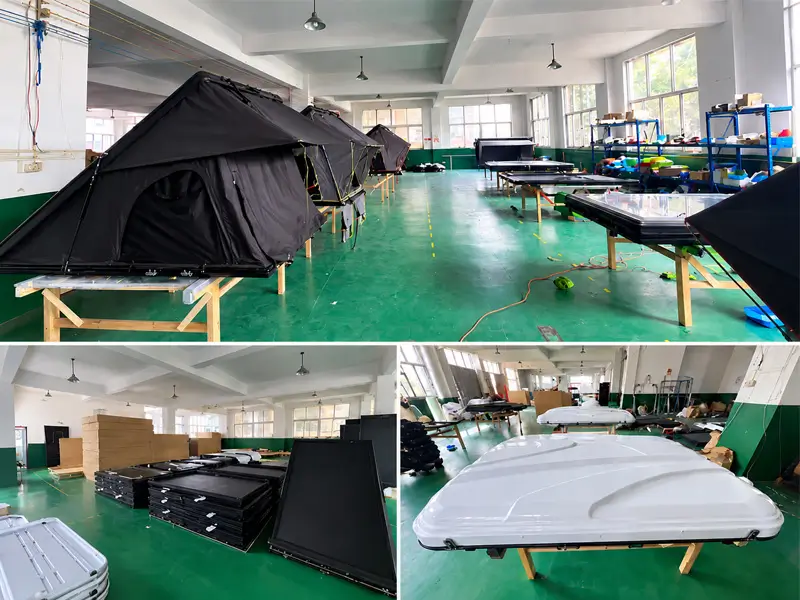
Shell mould quality
Look at the inside of the lid, not the outside. A good mould leaves an even wall with no thin patches around the corners, and no visible sink marks where the plastic cooled unevenly. Thin corners are where a shell cracks first.
Strut cycle testing
Ask how many open-close cycles the struts are tested to. A strut is a consumable — it will lose pressure — and a supplier who knows the cycle count also knows when to change the specification.
Seam sealing on the canvas
Hydrostatic head is measured on flat fabric, not on seams. Taped or welded seams are what actually keep water out of a tent rated at 8,000 mm; stitched-only seams leak at a fraction of that.
Frame welding and coating
The base frame carries everything. Check that the welds are continuous rather than spotted, and that the coating covers the weld — an uncoated weld is where corrosion starts on a vehicle that lives outdoors.
Carton protection
A 64 kg shell in a cardboard box crosses an ocean. Corner protection, foam blocking and a strapped carton are the difference between a clean delivery and a container of chipped lids.
For importers and distributors
This model is a hard shell rooftop tent with a thick ABS lid, dual hydraulic struts, an aluminium and stainless base frame, and an 8,000 mm coated Oxford canvas.
| Specification | Detail |
|---|---|
| Type | Hard shell, hydraulic lift, no assembly |
| Shell | Thick ABS |
| Struts | Dual hydraulic |
| Base frame | Aluminium with stainless reinforcement |
| Frame load rating | 400 kg |
| Canvas | Coated Oxford, 8,000 mm hydrostatic head |
| Openings | 2 doors, 2 windows, double-layer mesh |
| Interior height | 1.05 m |
| Mattress width | 1.2 m |
| Capacity | 2–3 people |
| Shell colours | Black / White |
| Canvas colours | Grey / Khaki / Army green / Coffee |
| Included | Crossbars, telescopic ladder, mattress, tool kit, guy lines, side pocket |
Packing
Carton configuration, colour split and lead time are quoted per order. We are a roof top tent supplier and exporter based in China; every hard shell rooftop tent manufacturer we work with has held the tooling for this shell for years. OEM and private-label production is available, including shell colour and canvas colour to specification.
The tent sits alongside the rest of our rooftop tent range.
Looking for a Best Hard Shell Rooftop Tent?
If you are a wholesaler, importer, distributor, outdoor retailer or rental operator, contact KEETU OUTDOOR to discuss sizes, colourways, OEM production and volumes.