
Ultralight hiking poles are not simply thin poles. Weight comes out of four places — the shaft taper, the number of sections, the grip and the lock — and each one you take weight out of is a place the pole can fail.
What “ultralight” actually means
Weight in a hiking pole is quoted per pole, not per pair, and the ranges are fairly consistent across the market:
- Under 200 g — usually carbon fibre. Light, stiff, and it fails without warning when it does fail.
- 200–250 g — the practical ultralight range for aluminium. Thin but not fragile.
- 250–320 g — standard aluminium poles. Durable, noticeably heavier in the hand.
- Over 320 g — heavy-duty or older designs, usually with an internal twist lock.
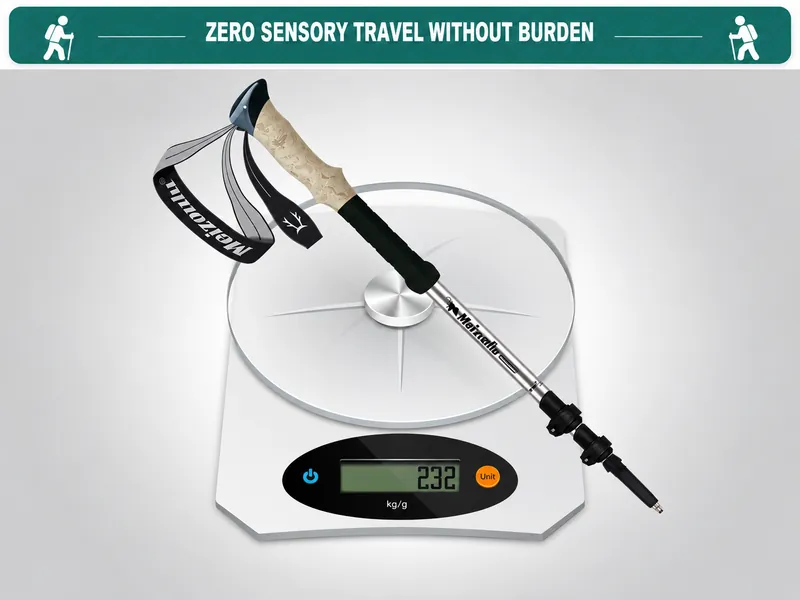
A pole at 232 g sits in the second band, which is why it makes sense to call it an ultralight hiking pole rather than simply a hiking pole. The difference is not academic: swing weight is multiplied by the square of distance from the shoulder, so 60 g saved at the far end of a pole feels like much more than 60 g in a pack.
Where the weight comes out
Shaft taper
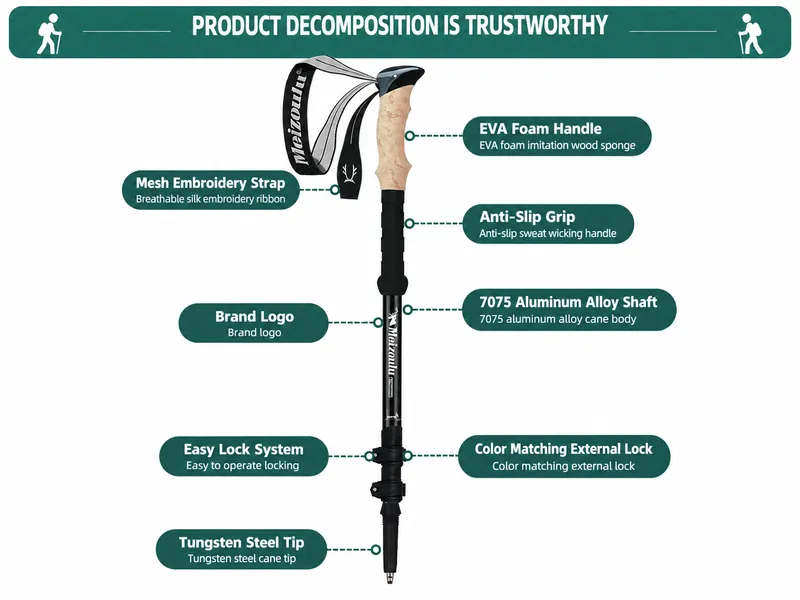
The three sections run 18 mm at the grip end, 16 mm in the middle and 14 mm at the tip. Tapering is the main reason a three-section pole can be light without being floppy: each section only carries the load it actually sees, so the lower sections do not need the same wall as the top one.
Number of sections
Three sections is the compromise. Two is lighter and stiffer but collapses to a long pack length; four collapses shorter but adds two more joints, and joints are where weight and flex both come from. Three sections at 63 cm collapsed fits inside most pack side pockets.
Grip
The grip is EVA foam, which is light and does not become slippery when wet. Foam grips save weight over rubber and over cork-and-rubber composites, at the cost of wearing faster on a pole used every weekend.
The trade-off: light versus durable
Taking weight out of an aluminium pole means taking wall thickness out of the tube. Below a certain point the pole dents instead of flexing, and a dented section will not slide.
Three details are what keep a light pole usable:
- Tapered sections — the bottom section is the thinnest but also takes the least bending, so the wall can be thin where it matters least.
- Tungsten steel tip — a hard tip wears slowly, which matters because a worn tip is the first thing to fail on a light pole. It also bites on rock rather than skidding.
- External lock in ABS — a lever lock clamps the section from outside, so the tube wall does not need internal reinforcement at the joint.
The 63–135 cm range
The adjustment range decides who the pole fits, not the weight. 63 cm collapsed is short enough for a pack side pocket; 135 cm extended covers most adult users on flat ground.
Setting it correctly:
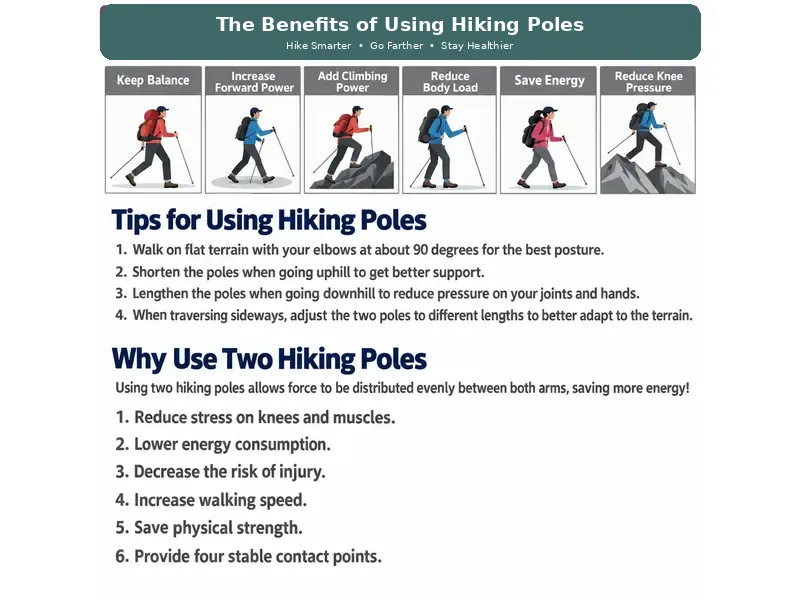
- Flat ground — tip on the ground, grip at hip height, elbow at about 90 degrees.
- Uphill — shorten by 5–10 cm. The ground comes up to meet the pole, and a shorter pole keeps the arm in a pushing position.
- Downhill — lengthen by 5–10 cm. This is the setting that takes load off the knees, and the one most people forget.
- Traversing a slope — set the two poles at different lengths so the downhill-side pole reaches the ground.
Ultralight hiking poles are usually bought as a pair for exactly this reason: one pole cannot be adjusted for both sides of a slope at once.
External lock versus internal
An external lever lock in ABS clamps the section from outside. The advantages over an internal twist lock are practical rather than technical:
- Adjustable with gloves on — a lever can be flipped with a thumb; a twist lock needs grip strength and a twist at the same time.
- Visible clamping force — you can see whether the lever is closed, which is not true of a twist lock.
- Nothing inside the tube — no expander to seize when grit gets in.
The trade is that a lever can catch on branches and get flipped open. On ultralight hiking poles this is the failure to check for before a walk, not during one.
Grip and strap
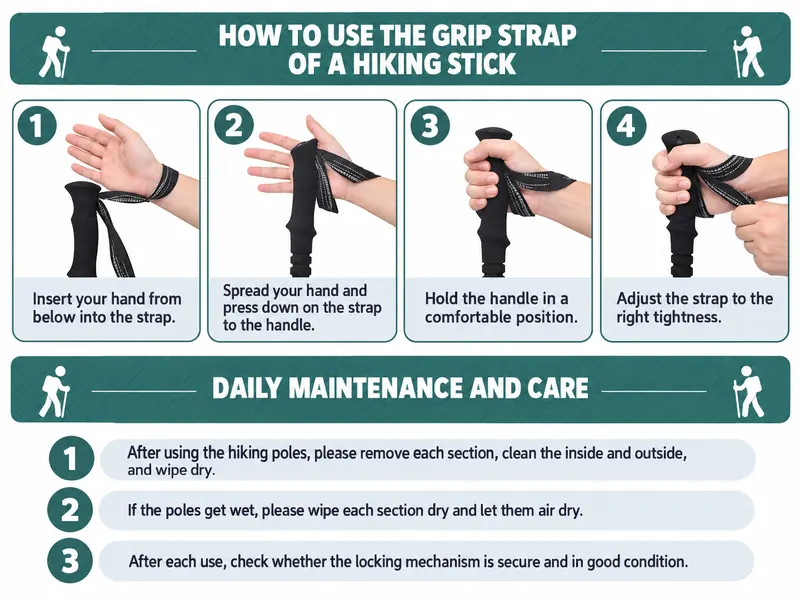
The strap is embroidered webbing rather than a flat nylon tape. Embroidery gives the strap a slight texture, which stops it sliding through a glove, and the weave is what carries the push on a climb.
How to hold it:
- Pass the hand up through the loop from below.
- Press the palm down onto the grip so the strap runs across the back of the hand.
- Close the hand at a comfortable position.
- Adjust the strap so the pole hangs from it when the hand is open.
Done the other way — hand through the loop from above — the wrist takes the load and the strap becomes a leash rather than a support.
Care
Three habits keep a light pole serviceable:
- Pull the sections apart and wipe them after use. Grit trapped inside the tube is what seizes a pole and what scratches the anodising.
- Dry before collapsing. Store wet and the inside of the sections corrodes.
- Check the locks before every walk. A lever that has worked loose is the failure mode that matters on a light pole.
Two things not to do: never use a pole as a rope to pull someone, and never extend past the STOP mark on the shaft. Both load the pole in a direction it was not designed for.
For importers and distributors
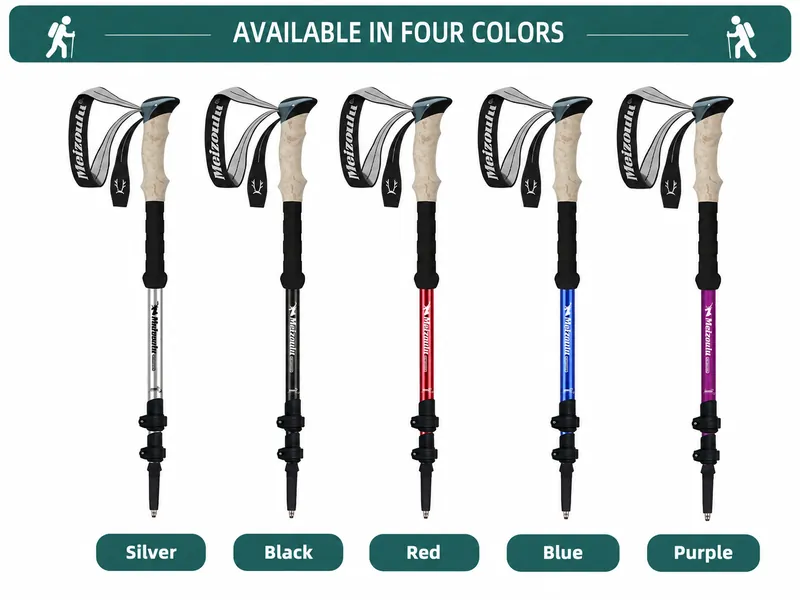
This model is a three-section aluminium alloy pole with a 18 / 16 / 14 mm tapered shaft, EVA foam grip, embroidered webbing strap, ABS external lock and tungsten steel tip. Five colourways are available.
| Specification | Detail |
|---|---|
| Sections | 3 |
| Shaft | Aluminium alloy, tapered 18 / 16 / 14 mm |
| Length range | 63–135 cm |
| Weight | Approx. 232 g per pole |
| Grip | EVA foam |
| Wrist strap | Embroidered webbing |
| Lock | ABS external lever lock |
| Tip | Tungsten steel |
| Colours | Red / Royal blue / Black / Silver / Purple |
| Use | Hiking, mountaineering, snow |
Packing
60 pcs per carton, carton size 69.5 × 45.5 × 25 cm, gross weight about 19 kg. Prices, colour split and lead time are quoted per order.
OEM and private-label production is available. The pole sits alongside our hiking poles range.
Looking for Ultralight Hiking Poles?
If you are a wholesaler, importer, distributor, outdoor retailer or rental operator, contact KEETU OUTDOOR to discuss colourways, packing and volumes.