
Kids hiking poles are sized by elbow angle, not by age. With the tip on the ground, the grip should sit at hip height and the arm should bend to roughly 90 degrees — anything else turns the pole into something the child carries instead of uses.
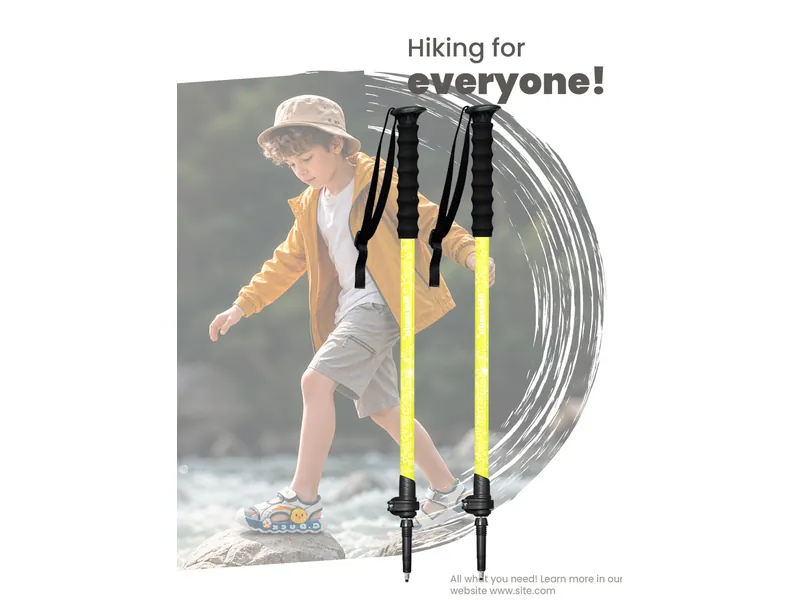
Why children use two poles, not one
One pole helps balance. Two poles change how the walk works. With both planted, a child has four points of contact instead of two, and the load that would go through the knees and ankles is shared with the arms.
For children the effect is bigger than for adults, because the legs are shorter and the pack is a larger fraction of body weight. Two poles reduce the load on the knee joint, cut the energy spent keeping balance, and give a stable point on loose ground — which is the part that prevents falls rather than the part that increases speed.
They also help on climbs. A child runs out of leg length before running out of energy; a pole lets them push with the arms as well, which is why poles earn their place on long uphill sections more than on flat ground.
How to size them
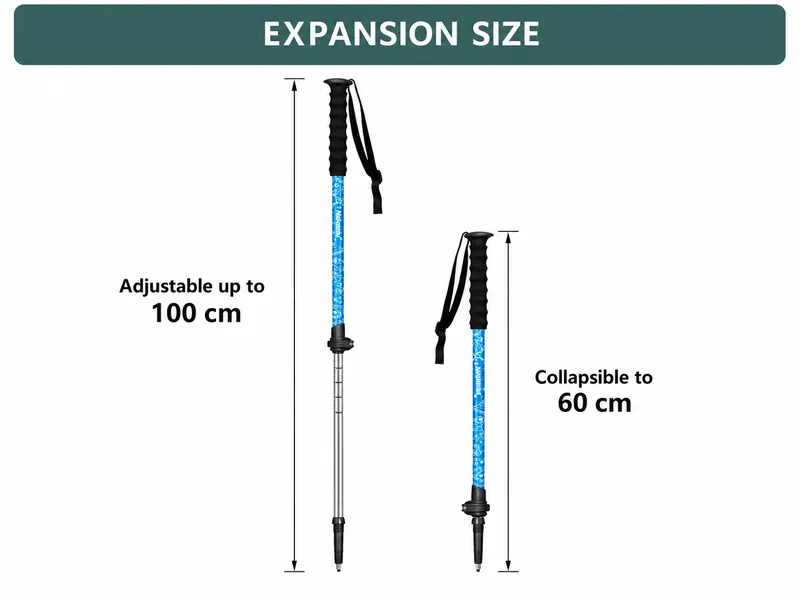
Stand the child up, put the tip on the ground, and check two things:
- Grip height — should sit at hip level
- Elbow angle — about 90 degrees with the hand on the grip
A pole set this way is the neutral length for flat ground. Everything else is adjusted from there:
- Uphill — shorten slightly. The ground comes up to meet the pole, and a shorter pole keeps the arm in a pushing position.
- Downhill — lengthen. This is the setting that takes load off the knees, and it is also the setting most people forget.
- Traversing a slope — set the two poles at different lengths, so the downhill-side pole reaches the ground without the uphill-side arm being lifted.
A 60–100 cm range covers users from roughly 100 cm to 160 cm in height. That is what makes an adjustable pair worth buying over a fixed-length one: the same poles follow a child through two or three growth seasons, and can be handed down afterwards.
What each part does
Five parts decide whether a pair of kids hiking poles gets used or carried.
The handle and the head
The handle is EVA foam. It absorbs sweat rather than becoming slippery, and it does not deform under a child’s grip the way softer foam does. The top of the handle is shaped as a protective head, so a child holding the pole by the top — which they will — has a rounded surface in the palm rather than the end of a tube.
The wrist strap
PP webbing, adjustable. The strap is what lets a child push against the pole on a climb without gripping hard, and it has to adjust down to a child’s hand rather than being shortened from an adult length. A strap that is too long makes the child hang on the strap instead of the grip, which puts the load on the wrist instead of the palm.
The shaft
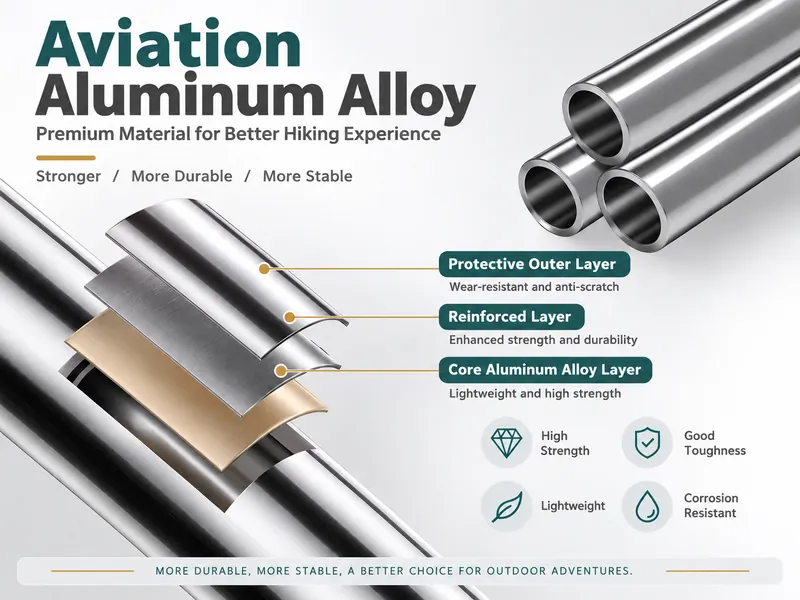
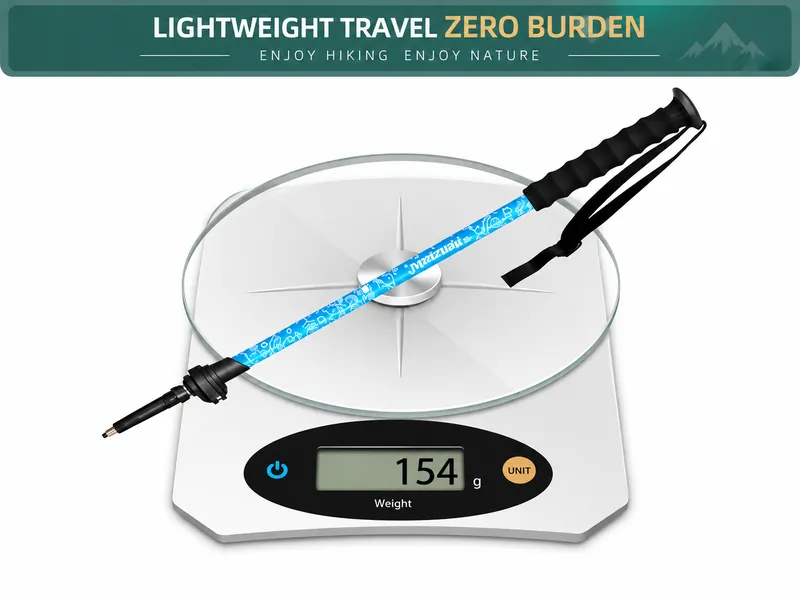
Aviation aluminium alloy, built in three layers: a protective outer layer, a hardened reinforcing layer, and an axial load-bearing core. The layering is why the pole can be light and still resist bending — 154 g per pole, which is the weight that decides whether a child plants the pole or drags it.
The lock
A double-layer external flip lock. External locks are easier for small hands than twist locks, which need grip strength and a twist at the same time. The double-layer structure holds the section in place after it is clamped, so the pole does not creep shorter during a walk.
The tip
Hardened steel, replaceable. A sharp tip bites into rock and hard ground; a rounded one slides. Tips wear out before anything else on the pole, which is why replaceable is the feature that matters for a pair used by more than one child.
How to hold the strap
Most children (and most adults) use the strap wrong. The correct sequence:
- Pass the hand up through the strap loop from below.
- Open the palm and press down onto the grip, so the strap runs across the back of the hand.
- Close the hand at a comfortable position.
- Adjust the strap tension so the pole hangs from the strap when the hand is open.
Done this way, the strap carries the push on climbs. Done the other way — hand through the loop from above — the wrist takes the load and the strap becomes a safety leash instead of a support.
Care and storage
Three habits keep a pair serviceable for years:
- Pull the sections apart and wipe them after use. Grit and moisture trapped inside the shaft is what seizes a pole.
- Dry them fully before collapsing. Store wet and the aluminium inside the sections corrodes.
- Check the lock before every walk. A lock that has worked loose is the one failure mode that matters.
Two things not to do: never use a pole as a rope to pull someone, and never extend past the STOP mark printed on the shaft. Both load the pole in a direction it was not designed for, and both are how poles snap.
For importers and distributors
Model M8619 is a two-section kids hiking pole in aviation aluminium alloy with an EVA handle, adjustable PP wrist strap, double-layer external lock and hardened steel tip.
| Specification | Detail |
|---|---|
| Model | KT-O1002 |
| Sections | 2 |
| Length range | 60–100 cm |
| Weight | Approx. 154 g per pole |
| Handle | EVA foam |
| Wrist strap | PP webbing, adjustable |
| Shaft | Aviation aluminium alloy, 3-layer |
| Lock | Double-layer external lock |
| Tip | Hardened steel |
| User height | Approx. 100–160 cm |
| Use | Hiking, mountaineering, snow |
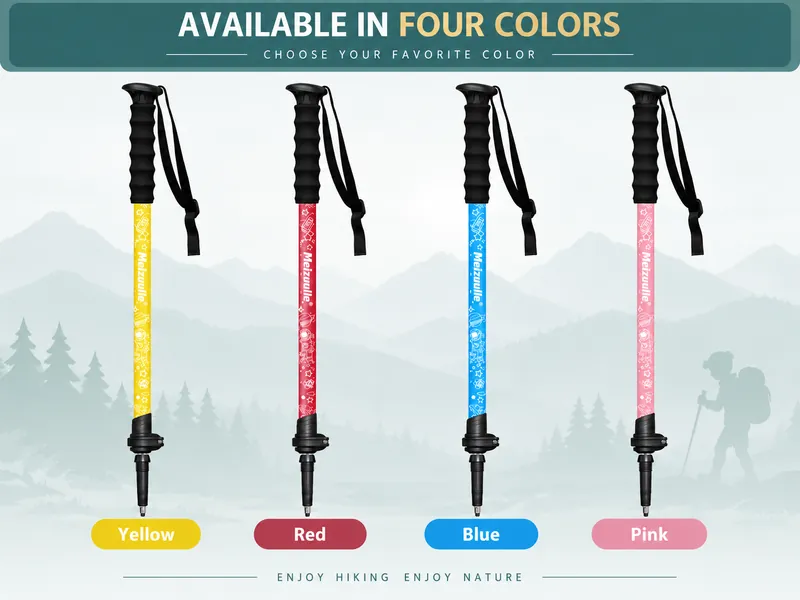
| Colours | Red / Blue / Fluorescent green / Pink |
Packing
Poles ship 60 pcs per carton, carton size 60.5 × 41 × 30.5 cm, gross weight about 16 kg. Prices, colour split and lead time are quoted per order.
OEM and private-label production is available. The pole sits alongside the rest of our hiking poles range.
Looking for a Kids Hiking Poles Supplier?
If you are a wholesaler, importer, distributor, outdoor retailer or school outfitter, contact KEETU OUTDOOR to discuss colourways, packing and volumes.