
How to clean kayak properly is really a question about the hull material. A clear boat is a polycarbonate shell, and polycarbonate has its own rules: what it tolerates, what attacks it, and what makes it go from clear to cloudy. Once you know the material, the routine takes ten minutes.
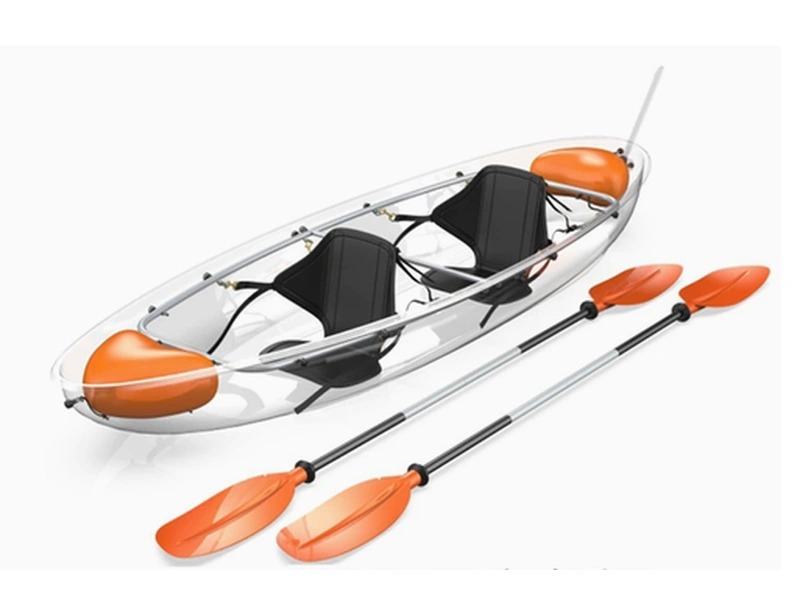
What a clear hull is actually made of
The shell on a transparent kayak is a single moulded polycarbonate piece. That material is chosen for three properties, and each one explains a cleaning rule later in this guide.
Light transmission is about 88%. That is what makes the boat look like glass — and it is also why any film, scratch or chemical haze is visible from the inside, where an opaque hull would hide it.
Impact strength is roughly 200 times that of ordinary glass. Polycarbonate bends under a hit rather than shattering, which is why these hulls survive beach launches and trailer straps without cracking.
The working temperature range runs about −40 °C to +120 °C. A hull that does not go brittle in cold water can still be damaged by heat, which is why storage in direct sun matters more than storage temperature.
The shell also carries a UV additive and a coating, and those are what stop the material yellowing. Anything that strips a coating shortens that protection — which is the single reason not to use household glass cleaner.
How to clean kayak after every trip
Rinse with fresh water. After salt water this is not optional: salt dries into crystals that abrade the hull every time it flexes. Lake and river water leaves silt in the scuppers, so rinse either way. A hose is enough — a pressure washer forces water past fittings and into foam sections.
Wipe the seat and rim. Fabric and foam hold water longest and mildew starts there, not on the hull.
Dry before storage. Stand the boat on its side or upside down so the cockpit and hatches drain.
Run a hand along the keel. A scratch that catches a fingernail is where a crack starts; a shallow one is cosmetic.
Once a month, and nothing more
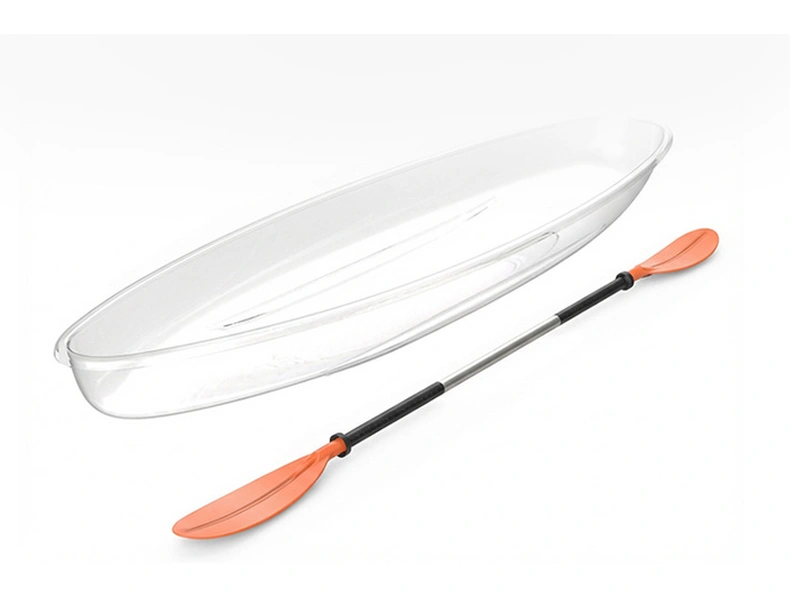
Wash the whole boat with a pH-neutral shampoo and a soft sponge or microfibre cloth, top down, then rinse and dry with a cloth rather than letting it air dry in sun, which leaves water spots on a clear surface. Remove the seat if it lifts out and let it dry in the open air for an hour — sunlight kills mildew spores that a wipe-down leaves behind.
Three things never to use
Abrasive pads and scouring cream leave a permanent matte patch that shows from inside. Ammonia-based glass cleaner turns clear into milky. Alcohol and solvent wipes craze the surface, and the damage appears months later as fine cracks under stress. Dish soap is acceptable occasionally but not as a habit, because the degreasers in it strip the UV protection built into the shell.
Haze, yellowing and scratches are three different problems
Haze after washing is a residue film — a fresh-water rinse and a microfibre dry remove it. Yellowing is UV exposure and cannot be washed off, so the answer is prevention rather than cleaning. Scratches are cosmetic: light ones polish out with a plastic polish made for polycarbonate, deep ones are better left than polished through the wall thickness.

How to store kayaks so the hull stays clear
Storage is where most of the long-term damage happens, and it answers most of the questions people have about how to store kayaks. Keep the boat out of direct sun — indoors, under a cover, or in shade — because UV is the main cause of fading and embrittlement. Support the hull on a rack, foam blocks or slings rather than letting it rest flat, so it does not take a set from its own weight. And never cover a wet boat: a cover over moisture is the worst combination, because it holds the humidity in.
Frequently asked
How often should you clean a kayak?
Rinse after every trip and wash with soap once a month in season. After salt water, rinse every single time.
Can you use dish soap?
Occasionally. Not as a routine — repeated use strips the UV protection.
Are clear kayaks worth it if they scratch?
Yes. Scratches on a polycarbonate hull are cosmetic and do not affect buoyancy, and the impact strength means a scratched hull is still a far tougher one than glass.
Can you pressure wash a kayak?
No. High pressure drives water past fittings and can lift decals; a hose and sponge do the same work safely.
How much does a clear kayak cost to keep?
Very little — water, mild soap, a cloth and a cover. There is no gel coat to wax and no fabric to re-waterproof.

For importers and distributors
The hull described here is our clear kayak: a moulded polycarbonate shell in three sizes from 2.4 m to 3.6 m, UV stabilised, supplied with fittings to order. We are a clear kayak supplier and exporter based in China, and every clear kayak manufacturer we work with has held the hull tooling for these sizes for years. We supply wholesalers, importers, distributors and rental operators with factory-direct pricing, OEM and private-label production, and MOQ quoted per order. Carton configuration and lead time are confirmed per order. See the rest of our kayak range.
Looking for a Clear Kayak Supplier?
If you are a wholesaler, importer, distributor, rental operator or outdoor retailer, contact KEETU OUTDOOR to discuss sizes, fittings, packing and volumes.