
Every pop up privacy tent looks the same in a product photo. The one test that separates a tent people keep using from one that ends up in the garage is simple: stand outside it at midday and see whether you can read the shape of the person inside. Everything below follows from that question.
Black coating or silver coating
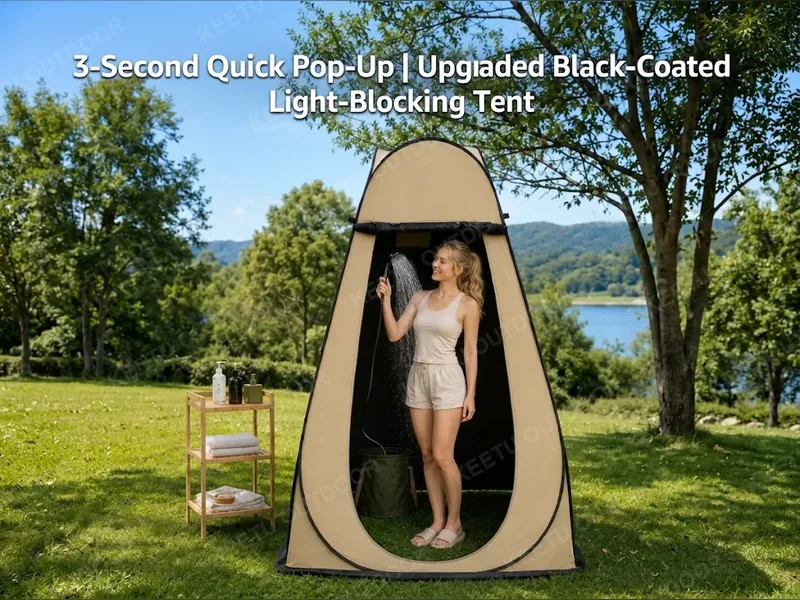
Most cheap privacy tents use a silver coating sprayed onto the inner face. It reflects light back, which works in weak sun, but it is a surface treatment: once it scuffs or the fabric stretches, light comes through and the outline of a body returns. That is why a camping privacy tent that looked opaque in the shop can be see-through at a campsite at four in the afternoon.
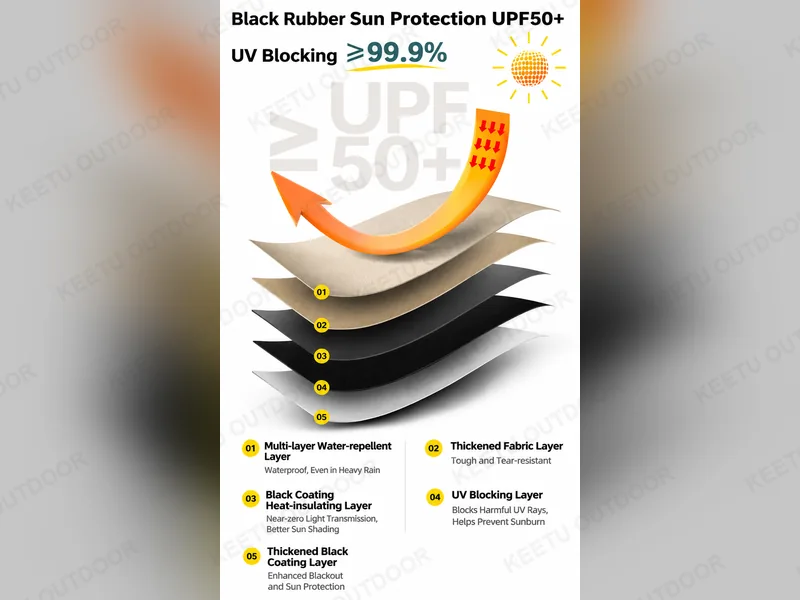
This one uses a black coating bonded as a layer instead. The build is five layers: a water-repellent outer face, a thickened fabric layer for tear resistance, a black heat-insulating coating, a UV blocking layer, and a thickened black coating inside. Light transmission is close to zero, UV blocking is rated UPF 50+ at 99.9%, and the black layer also stops the interior turning into an oven — the second complaint people have about privacy tents in summer.
Single or double: 120 cm against 150 cm
The two sizes read as a small difference on paper and feel like a large one inside. At 120 × 120 × 190 cm, one adult can stand, turn and change without touching the walls. At 150 × 150 × 190 cm, a parent can help a child change at the same time, or one person can shower with a bag and a stool beside them.
If the tent is bought as a pop up changing tent for one person, the 120 cm is enough. If it has to work as a portable changing room for two — a couple at a beach changing tent where there is nowhere else to change, or a family at a festival — the changing tent to buy is the 150 cm. Weight is 2.0–2.1 kg against 2.2–2.25 kg and packed size is 58 cm against 60 cm, so the choice is not about carrying; both fit a car boot.
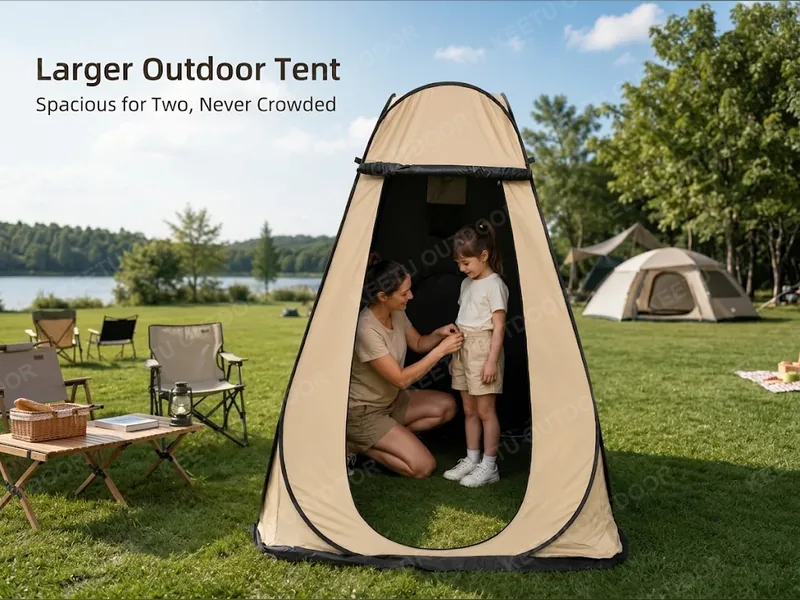
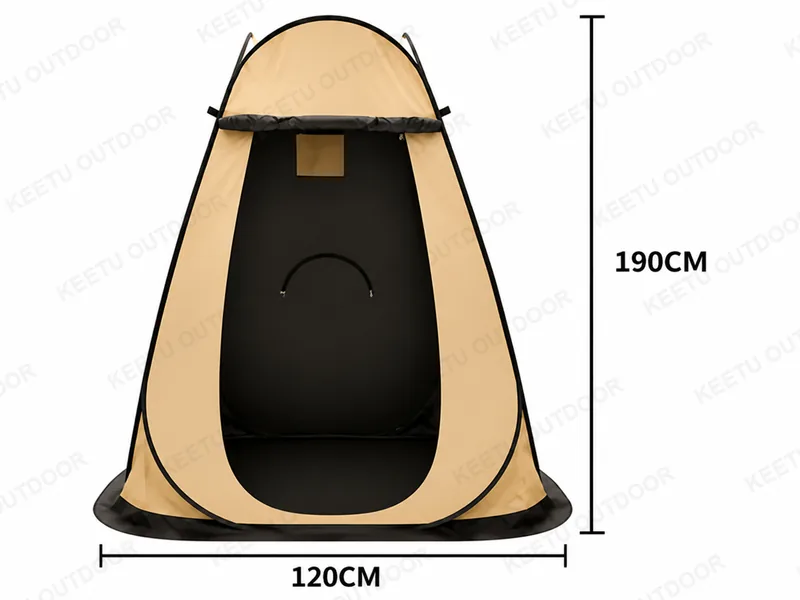
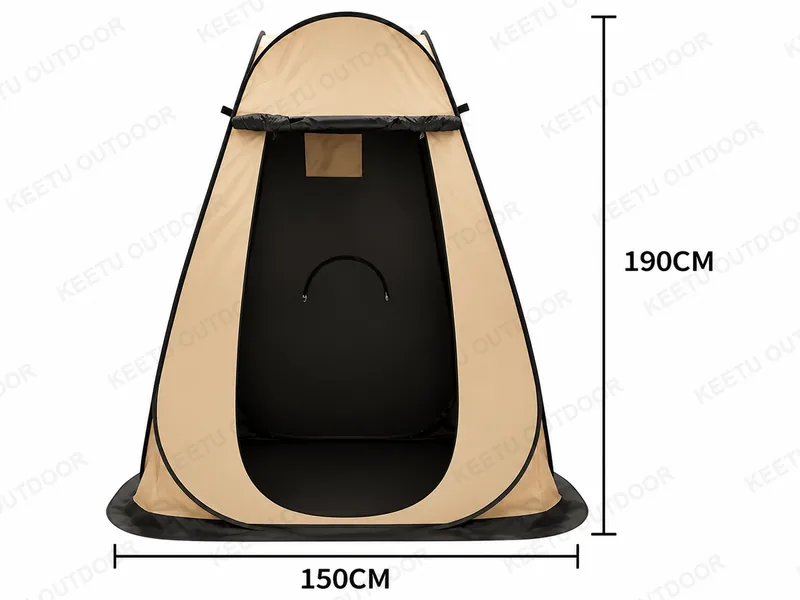
150 cm with two people inside, next to the 120 cm and 150 cm footprints.
Three seconds to open, four steps to close
The frame is an elastic flat steel sheet, so opening is literal: take it out of the bag, throw it into the air, and the frame springs into shape as it lands. Nobody struggles with that part.
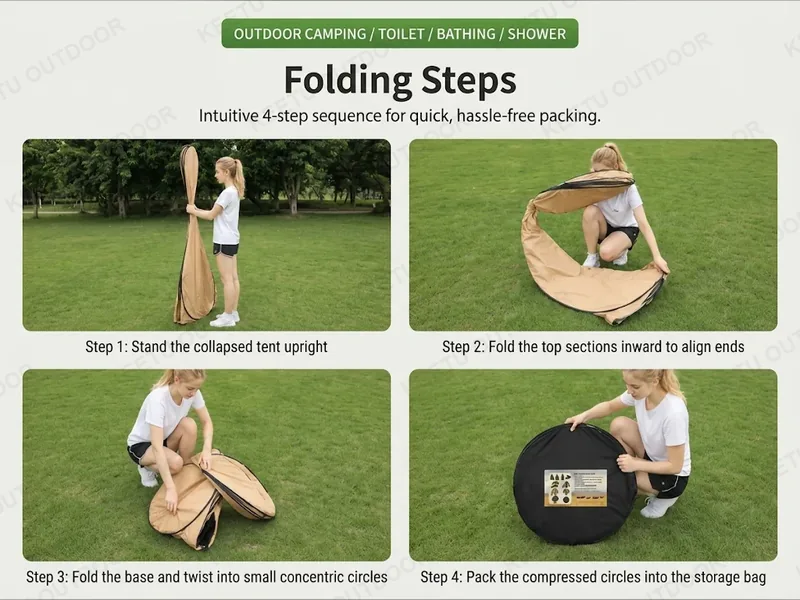
Closing is where these tents get returned. The sequence is four moves: stand the collapsed tent upright, fold the top sections inward so the ends line up, fold the base and twist it into concentric circles, then pack the compressed disc into the bag. Once learned it takes about fifteen seconds, and the folded tent is a 4 cm disc on a shoulder strap rather than something you wrestle into a boot — which is what makes it usable as an outdoor portable changing room for market stalls, job sites and rental fleets.
Which internal details actually get used
Feature lists on this type of product are long, and half of them never get touched. A hanging strap across the roof does get used — it holds a towel, a change of clothes, or a shower bag above the wet floor. An internal pocket does get used, because soap and a phone otherwise end up in the mud. A door tie does get used, because a door that will not stay open is a door you fight every time.
The skirt is the one detail buyers underrate. A widened hem sitting close to the ground blocks wind at ankle height, which is where most of the draught inside a pop up dressing room comes from. On hard ground it keeps splash out as well. Two or three windows and a clothesline are the rest of it — useful, in that order.

Four assumptions worth checking
It will be stuffy. Only if the windows cannot be opened from inside. What a portable restroom tent needs is height and ventilation, and the three-window version has both: a top skylight, an upper rear window and a lower rear window at seated height, all zipping from the inside.
It is only for changing. The same shell works as a pop up toilet tent around a portable toilet, and as a portable porta potty tent on a campsite where the facilities are a long walk away. Because the base is floorless, waste and water do not pool at your feet — the reason an outdoor toilet tent on a job site is usually this shape rather than a floored cabin.
It cannot be used for showering. It can. Hang a bag from the roof strap and the unit becomes a privacy shower tent with a floorless base that drains. If you are comparing models, the shower privacy tent detail that matters is the lower rear window, because that is where a hose enters without cutting the fabric.
It will blow over. An empty pop up tent has the sail area of a small spinnaker. Four pegs and four guy lines come with it for a reason, and the lines should go to the top corners so the tent is held in tension rather than just held down.

For trade buyers
We are a pop up privacy tent supplier and exporter based in China. Each privacy tent manufacturer we work with has held the tooling for this range for years, which is why the four models share one frame and one shell. We supply wholesalers, importers, distributors and outdoor retailers with factory-direct pricing, OEM and private-label production, custom colours on volume orders, and MOQ quoted per order. Sizes and skirt options can be mixed in one order. See the rest of our camping tents range.
Need a privacy tent range for your market?
Send us the sizes, window count and quantities you need. We will confirm carton split, colours and lead time before you order.