
The best camping wagon is not the one with the biggest number printed on the box. It is the one whose frame does not twist under load, whose wheels roll on grass, and whose fabric survives being dragged over gravel with a cooler in it.
What a camping wagon actually has to do
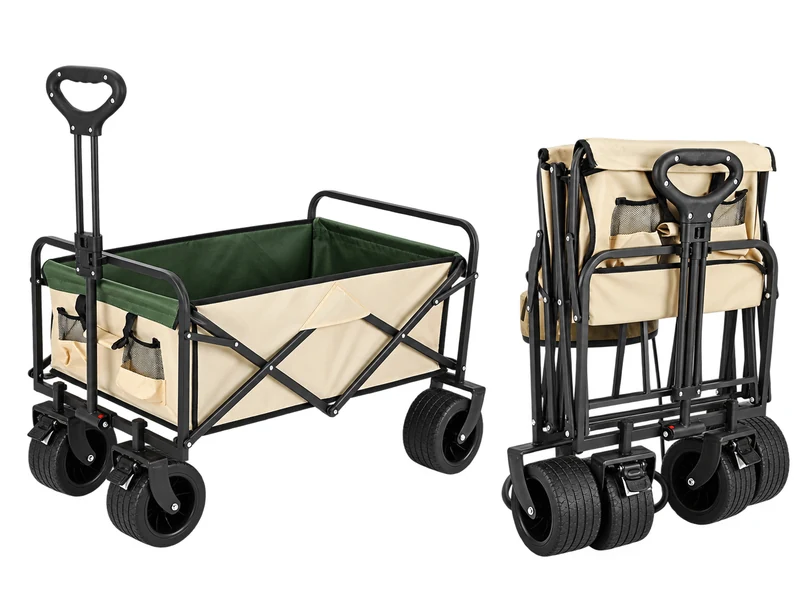
A wagon is a load-bearing box on wheels that gets dragged, not driven. That single sentence explains most of the design decisions: the frame has to resist racking when one wheel drops into a rut, the fabric has to resist abrasion from the load moving inside it, and the wheels have to roll on soft ground rather than cut into it.
Most failures happen at the joints, not in the tube. A wagon loaded to its rating and pulled across uneven ground puts a twisting load through the frame every time a wheel drops — the X-brace is what resists that, which is why cheap wagons use flat bar bent into a rectangle instead.
Two modes: hauling, then a table
Almost every wagon does the hauling job. This one does a second job as well, and that is the whole argument for it.
Hauling mode is the obvious one: box open, load it, pull it to the pitch. Table mode is the one that changes how the wagon gets used for the rest of the trip — fit the tabletop panel over the open box and the wagon becomes a camping table at working height, with everything you moved still inside it.
Count what that replaces. A family camping setup normally includes a wagon and a folding table. The wagon is used for ten minutes at each end of the day; the table is used for every meal. A wagon that becomes the table is one item doing both, which is less to pack, less to carry and one less thing to buy.
The tabletop is an optional accessory, not part of the base wagon, so check what is included when comparing prices. What makes table mode work is the height: the frame stands about 101 cm to the handle, which puts the box top at a height you can sit at, rather than the knee-height surface you get from a box on the ground.
Beyond camping
Both modes work away from a campsite — moving boxes between a car and a flat, carrying shopping, taking parcels to a drop-off point, using the tabletop as a side table in a garden. A wagon that only works on grass stays in the shed; one that works on a pavement gets used every week.
What separates the best camping wagon from the rest
The frame
Steel tube with an X-brace on every side. The brace is the part that stops the box turning into a parallelogram when the load shifts. Heavier gauge tube resists denting, and a coated frame resists rust on a wagon that lives in a shed.
What to avoid is flat bar folded into a rectangle: it looks tidy and it folds flat, but it has almost no resistance to racking, so the wagon leans the first time it is pulled diagonally across a slope.
The wheels
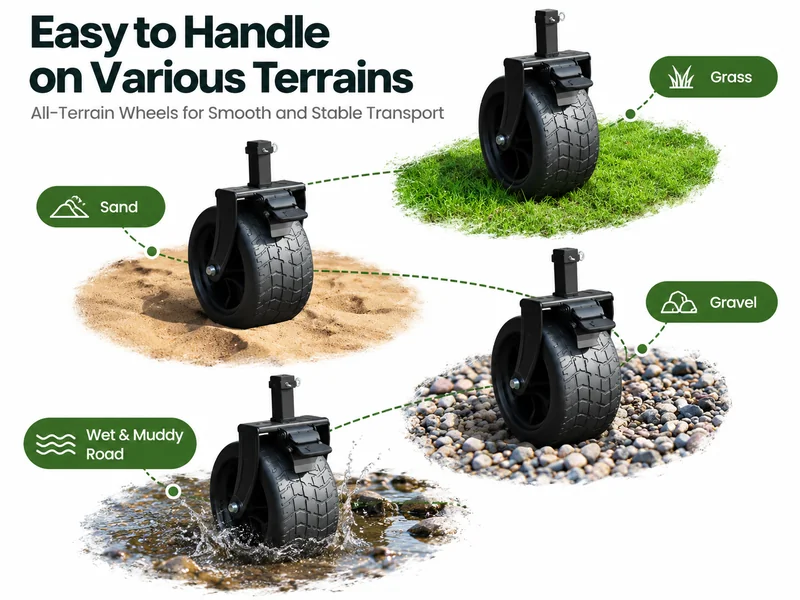
Two things matter: width and bearings. Wide wheels spread load on grass and sand; narrow wheels cut in and the wagon ploughs. Bearings decide how it feels to pull — a bushing wheel drags from the first metre, a bearing wheel rolls.
Brakes are the third thing. A loaded wagon on a slope with no brake is a runaway. Two braked wheels is the minimum for a wagon rated above about 150 kg.
The fabric
Denier is the yarn weight. 600D Oxford is the grade used on luggage and on wagon bodies that are expected to last; 300D is what you find on wagons sold on price. Double-layer at the base matters more than a higher denier on the walls, because the base is what wears against the ground and the load.
How it folds
A wagon that folds badly does not get used. The good pattern is the one that collapses inward on its own X-braces and latches flat, so it slides into a boot without being wrestled.
Payload: what the rating means
Wagon payloads are usually quoted in the highest number the frame survived once, not the load it carries comfortably. A realistic reading of a 250 kg rating is: it will carry 250 kg on flat ground, and it will be pleasant to pull at around half that.
For context, the loads a family wagon actually sees:
- Camping kit for four — tent, sleeping bags, stove, cooler, chairs: roughly 60–90 kg.
- Beach or festival day — cooler, chairs, umbrella, bags: roughly 30–50 kg.
- Garden and DIY — bags of compost, tools, timber: 80–150 kg.
A 250 kg rating therefore leaves real margin, which is what you want: a frame worked at its limit flexes, and a flexing frame fatigues at the welds.
Capacity: 300 litres and the fold-out panels
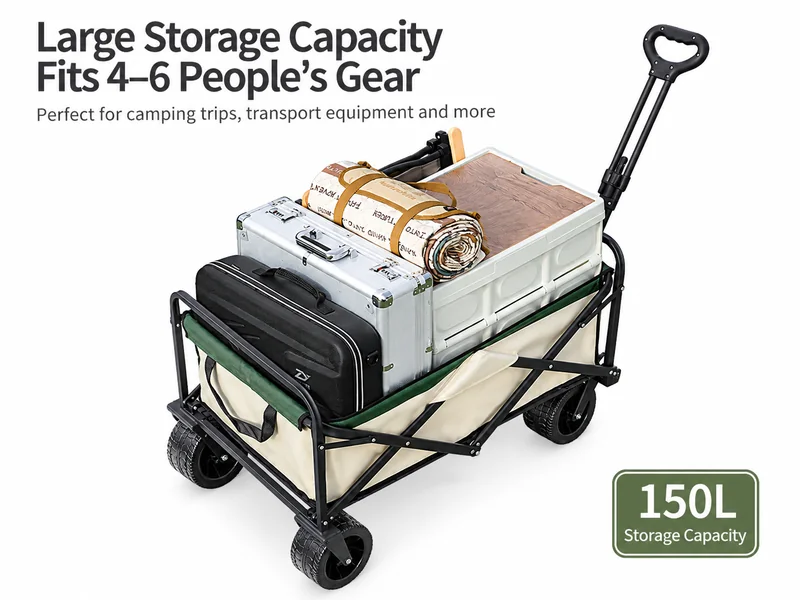
Volume is quoted with the wagon fully extended, which on this model means the fold-out panels at the front and rear are deployed. That takes the body from an 82 cm frame to about 120 cm of usable length, and the capacity to 300 litres.
In practice the panels are what make a wagon useful for long items — a rolled mat, a folding table, a bundle of firewood — that would otherwise have to be balanced on top. Folded down, the wagon is a compact box again.
Folding and car boot fit
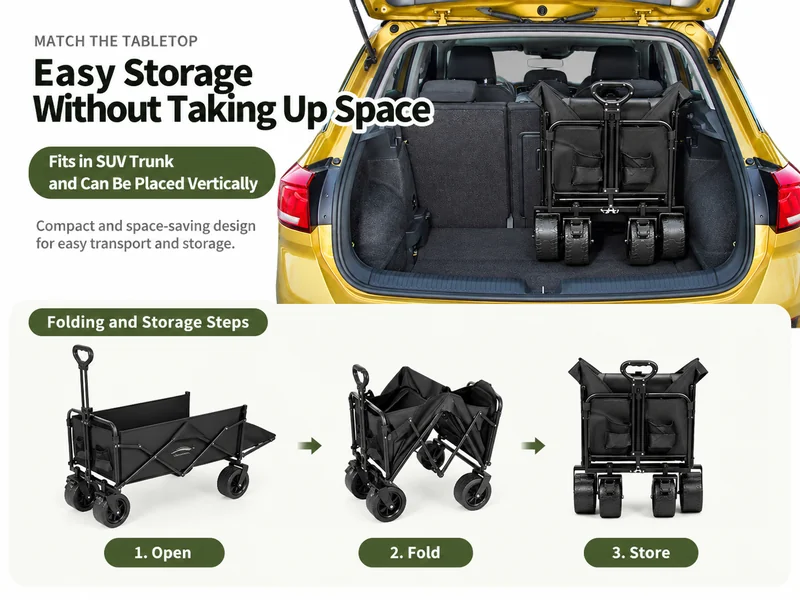
Folded, this wagon measures about 56 × 24 cm and weighs 10 kg — small enough to stand upright in the boot of a small hatchback rather than needing the seats down.
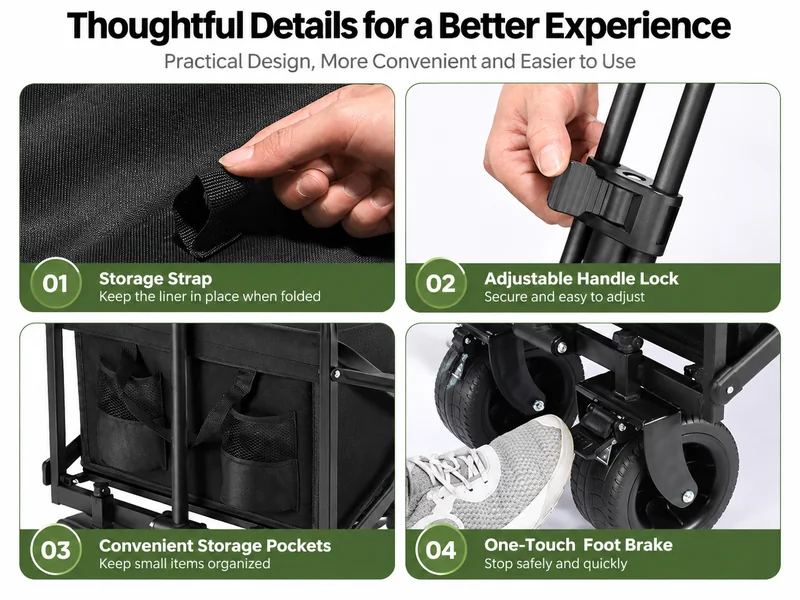
The fold itself is a three-step motion: lift the base strap, pull the sides toward the centre, clip the base panel. That is the pattern worth checking on any wagon, because a wagon that needs two people to fold will stay unfolded in the garage.
The handle
Two adjustments matter, and most wagons only have one. Length sets the pulling height so the wagon does not tip forward on a downhill; angle lets the handle drop to the ground without the wagon tipping when you stop.
A handle that only adjusts in length forces a tall user to pull at an awkward angle, which is the fastest way to make a loaded wagon feel heavier than it is.
For importers and distributors
This model is a folding camping wagon with a carbon steel X-braced frame, 600D double-layer Oxford body, bearing wheels with dual brakes, and fold-out panels front and rear.
| Specification | Detail |
|---|---|
| Frame | Carbon steel, X-braced |
| Fabric | 600D double-layer Oxford |
| Capacity | 300 L with panels extended |
| Payload | 250 kg |
| Frame size | 82 × 50 cm, 101 cm to handle |
| Length extended | About 120 cm |
| Folded size | About 56 × 24 cm |
| Weight | 10 kg |
| Wheels | Bearing hubs, dual brakes, wide tread |
| Handle | Adjustable length and angle |
| Liner | Removable, washable |
| Tabletop panel | Optional accessory — converts to a camping table |
| Colours | Obsidian black / Beige white |
Packing
Carton configuration, colour split and whether the tabletop is bundled are quoted per order. OEM and private-label production is available.
The wagon sits alongside the rest of our camping accessories range.
Looking for the Best Camping Wagon Supplier?
If you are a wholesaler, importer, distributor, outdoor retailer or rental operator, contact KEETU OUTDOOR to discuss colours, tabletop bundles, packing and volumes.