
A led camping lantern is judged on three numbers, not on how it looks on a shelf: how many lumens it puts out, how long the cell lasts at that output, and whether the light is warm or white. Everything else on a led camping lantern is finish.
What a led camping lantern actually is
Two different products get sold under this name, and they behave nothing alike.
The first is a lantern in the old sense: a light source inside a cage or globe, throwing light in every direction, usually with a hook on top. It lights a circle around itself. The second is a panel light: a flat array of LEDs on one face, often with a magnet or a folding stand, designed to light one direction — a table, a wall, a workspace.
Lanterns are for living space. Panels are for tasks. A led camping lantern of the first type, hung from a tent pole, lights the whole interior softly; a panel pointed at a stove lights the stove and nothing else. Most camping kits end up with one of each, which is why the two get confused on listings.
Lumens: how much light you actually need
This lamp uses a COB (chip-on-board) LED rather than individual bulbs. A COB array puts many small emitters on one surface, so the light comes out even rather than in visible dots — which is why a lantern of this type does not cast hard shadows across a tent.
Lumen figures on camping lights are frequently inflated, so the useful question is not “how bright” but “how bright at the setting I will actually use.”
- 10–20 lumens — a night light. Enough to find a zip in the dark, not enough to read.
- 20–50 lumens — tent interior. Reading, sorting gear, changing clothes.
- 50–100 lumens — a small group around a table, cooking, eating.
- 100–200 lumens — lighting a whole camp area, or a large tent.
For a led camping lantern, a dimmable range matters more than a high maximum. A lantern fixed at 200 lumens is too bright to sit next to inside a tent; one that steps between 20 and 200 covers both uses. This lantern runs 20–200 lumens on a rotary dimmer, which is the range that makes a single lamp usable for reading and for lighting a table.
Battery: what a led camping lantern actually needs
The rechargeable version of a led camping lantern runs a single 18650 lithium cell at 1,200 mAh, driving a 5 W COB LED, and gives roughly 10 hours of use per charge depending on the dimmer setting.
What that means in practice:
- Runtime scales with output. Ten hours is at reduced brightness; run at full output and the same cell gives noticeably less.
- Charge time matters as much as runtime. USB-C at about 3 hours to full is the figure to check — a lantern that takes 8 hours to charge is a lantern that spends the trip on a cable.
- 18650 is replaceable in principle, but most housings are sealed. Treat the cell as part of the lamp, not a consumable.
The dry-cell version of the same lamp runs on 3 × AA batteries, not included. It suits rental fleets and hire stock: no charging discipline, no cables, no cells that go flat in storage. The trade is that you buy batteries forever, and AA output drops as the cells drain.
Warm light vs white light
This is the difference people notice first, and on a led camping lantern it is not a cosmetic choice.
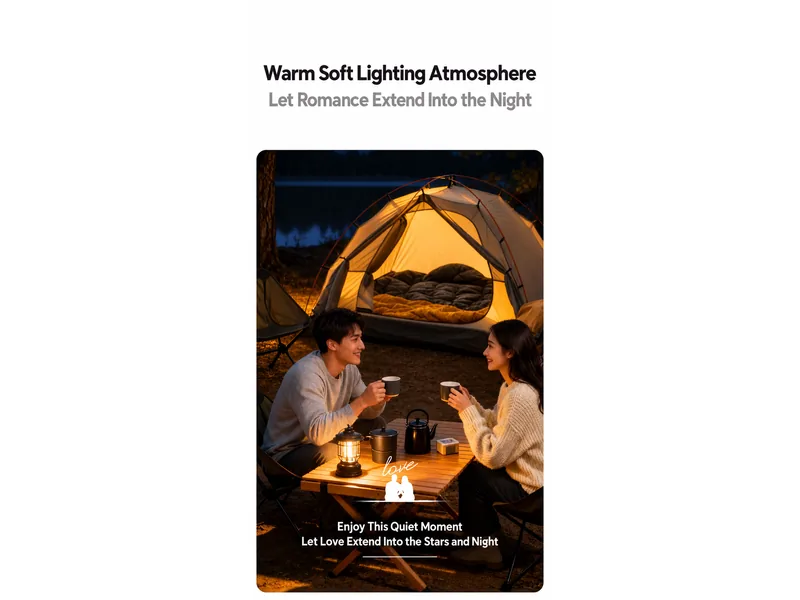
Warm light (roughly 2,700–3,000 K) reads as candlelight. It is comfortable to sit in, does not kill night vision as fast, and photographs well. It is the wrong light for finding a black zip in a black bag, because warm light flattens colour.
White light (roughly 5,000–6,500 K) is what you want for tasks: cooking, repairs, first aid, reading a map. It renders colour accurately and looks harsher across a campsite.
This lantern is sold in two versions along that line: the rechargeable version runs warm (yellow) light, and the dry-cell version runs white. That split is deliberate — the rechargeable one is a living-space lamp, the battery one is a task lamp.
Weather resistance
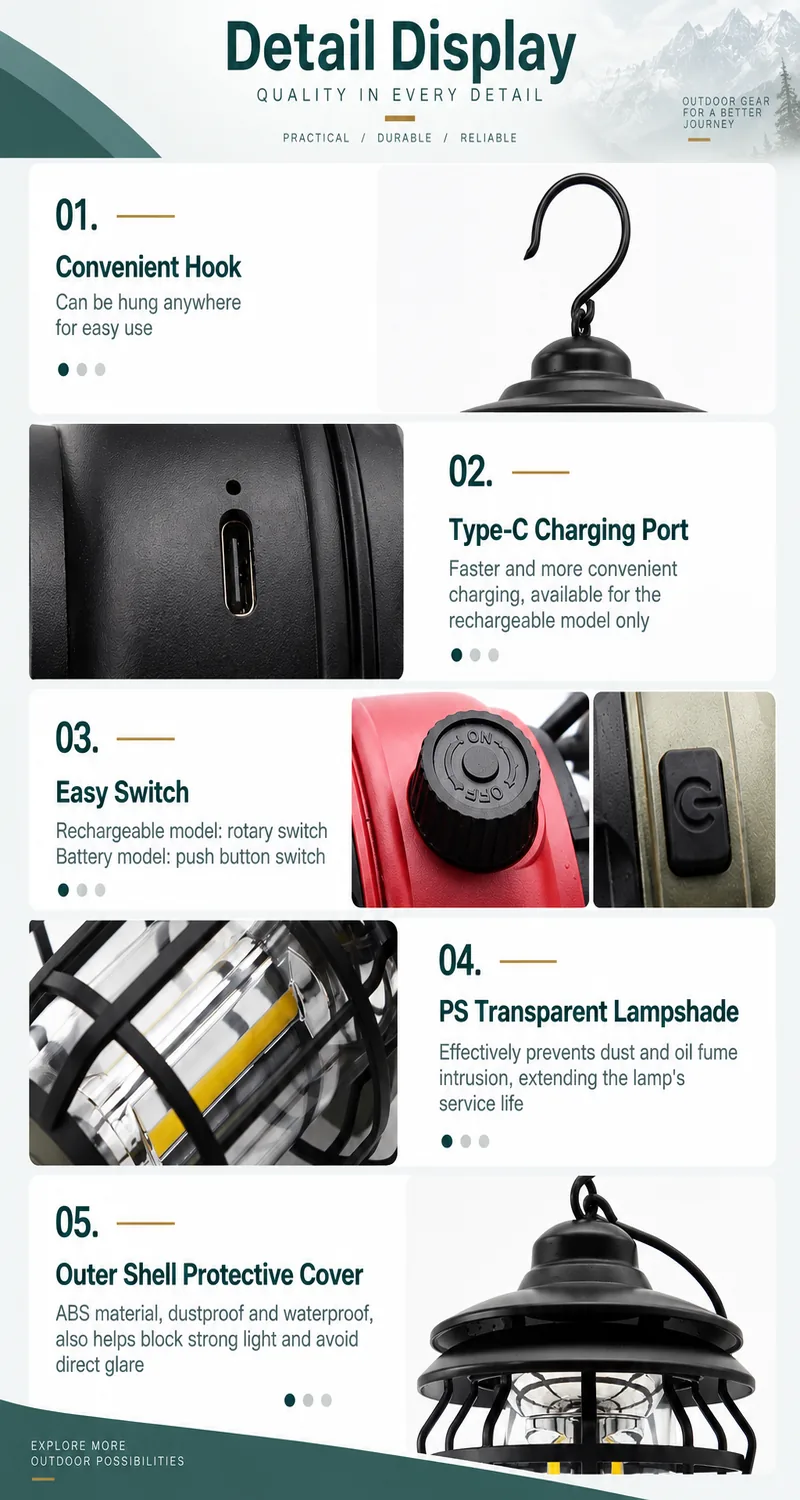
A led camping lantern gets rained on, dropped in wet grass and left out overnight. The housing is ABS with a PS diffuser and a PP reflector, which is the normal build for this class: ABS takes knocks, PS transmits light, PP reflects it.
What to check on a listing is not the word “waterproof” but the actual rating. A lantern described only as outdoor-ready is splash resistant at best; it is not a lamp to leave standing in a puddle. If a supplier cannot give you an IP number, assume no rating.
Hang, carry or stand
Three mounting modes on a led camping lantern come from two parts: a steel wire hook on top, and a flat base with an oversized non-slip pad.
- Hanging — from a tent pole, a ridge line, an awning frame. The hook is why a lantern lights a whole shelter from one point instead of casting shadows from the floor.
- Carrying — the same hook doubles as a handle for walking to the wash block.
- Standing — the widened base is what stops the lamp tipping on uneven ground or on a table with a slope.
The rotary dimmer sits on the body rather than the top, which matters when the lamp is hanging: you can reach up and turn it without taking the lantern down.
What to check before ordering a batch
For buyers stocking a led camping lantern, four things decide whether a container sells through:
- Version split — how many rechargeable vs dry-cell units. Rechargeable sells to consumers; dry-cell sells to rental operators and to markets where charging is unreliable.
- Colour temperature consistency — warm light varies between batches. Ask for a sample from production, not a studio photo.
- Carton weight — this model ships 60 pcs per carton at 21 kg gross, which stays under most manual handling limits. Heavier cartons cost more to move and get damaged more.
- Charging port — USB-C is now expected; micro-USB stock will sit.
LED Camping Lantern: Specifications
| Specification | Detail |
|---|---|
| Housing | ABS |
| Diffuser | PS |
| Reflector | PP |
| Guard | ABS |
| Hook | Steel wire |
| LED type | COB |
| Power | 5 W |
| Voltage | 3.7–4.2 V |
| Output | 200 lm maximum, stepless rotary dimming |
| Battery | Rechargeable: 18650 lithium, 1,200 mAh Dry-cell: 3 × AA (not included) |
| Runtime | Up to about 10 hours |
| Charging | USB-C, about 3 hours to full |
| Size | 115 × 186 mm (diameter × height) |
| Net weight | 260 g |
| Light colour | Rechargeable: warm. Dry-cell: white |
| Packaging | Colour box |
Packing
60 pcs per carton, carton size 62.5 × 50 × 61.5 cm, net weight 20 kg, gross weight 21 kg. Prices, version split and lead time are quoted per order.
OEM and private-label production is available. The lantern sits alongside the rest of our camping accessories range.
Looking for a LED Camping Lantern Supplier?
If you are a wholesaler, importer, distributor, outdoor retailer or rental operator, contact KEETU OUTDOOR to discuss version split, colour temperature and volumes.